 travelandlearns
Related Articles



When I travel, one thing I never like to worry about is my phone battery dying at the wrong time. Whether I am using Google Maps to find a hotel, checking a boarding pass, taking photos, calling family, or simply listening to music during a long journey, my phone has become an important part of travel. This is why I consider a good travel power bank one of the most useful gadgets to carry.
However, choosing the right power bank is not always as simple as picking the one with the biggest battery capacity. There are different sizes, charging speeds, ports, safety features, and designs available. Some power banks are perfect for short trips, while others are better for long journeys or travelers carrying multiple devices.
In this guide, I will explain how to choose a travel power bank based on the things I believe matter most. My goal is to help you understand what to look for so you can choose a power bank that is practical, reliable, and suitable for your travel needs.
Consider the Battery Capacity
The first thing I look at when choosing a travel power bank is battery capacity. Power bank capacity is usually measured in mAh, which means milliamp hours.
For everyday travel, a power bank between 10,000 mAh and 20,000 mAh can be a practical choice. A 10,000 mAh model is usually easier to carry and can provide useful extra battery life without adding too much weight to your bag.
If I am going on a longer trip, I would normally prefer a 20,000 mAh power bank because it provides more backup power. It can be especially useful when I know I will spend several hours away from a wall charger.
Larger capacities can sound attractive, but bigger does not always mean better. A high capacity power bank can be heavier and take longer to recharge itself. For this reason, I recommend choosing the capacity according to the length and type of your trip.
Check the Charging Speed
Battery capacity is important, but charging speed is equally useful. A power bank with a large capacity can still be frustrating if it charges your phone very slowly.
When choosing a travel power bank, I recommend checking its output power. Modern smartphones can support fast charging, so a power bank with suitable fast charging support can save a lot of time.
USB C Power Delivery, commonly called USB C PD, is an important feature to look for. Depending on the model, USB C PD can provide fast charging for compatible smartphones, tablets, and even some laptops.
From my point of view, fast charging is particularly valuable during travel because we often have limited time. If I have only a short break at an airport or cafe, I want my phone to gain as much battery as possible instead of waiting for hours.
Choose the Right Size and Weight
A travel power bank should be easy to carry. There is little benefit in having a powerful device if it is so large and heavy that you do not want to take it with you.
For everyday trips, I prefer a compact power bank that can easily fit inside a small backpack or travel pouch. Smaller models are also convenient when walking around a city because they do not add unnecessary weight.
If you are traveling with several devices, a larger model may make more sense. The key is to find a balance between capacity and portability.
Before buying, I suggest checking the actual dimensions and weight rather than judging the product only by its pictures. A power bank may look compact online but feel surprisingly heavy in your hand.
Look at the Available Ports
Another important factor is connectivity. Different power banks come with different combinations of USB A and USB C ports.
If most of your devices use USB C, I would recommend choosing a power bank with at least one USB C port. Some models also allow USB C to be used for both input and output, which can make charging more convenient.
Multiple ports are useful if you travel with a phone, wireless earbuds, smartwatch, camera, or tablet. Instead of carrying separate chargers or waiting for one device to finish charging, you may be able to charge several devices from the same power bank.
Still, I would not choose a power bank simply because it has many ports. Check the total output and whether the power bank can maintain useful charging speeds when multiple devices are connected.
Think About Your Devices
Before buying a travel power bank, make a list of the devices you normally carry.
If you only need to charge a smartphone, a compact 10,000 mAh power bank may be enough for your needs. If you carry a tablet or other larger devices, you may want a higher capacity model.
Laptop charging requires extra attention. Not every power bank can charge a laptop. If laptop charging is important to you, check whether the power bank supports the required USB C Power Delivery output and whether its wattage is compatible with your laptop.
I think this is one of the most important buying decisions because the best travel power bank is not necessarily the most expensive one. It is the one that works properly with the devices you actually use.
Check Airline Travel Requirements
If you plan to take your power bank on an airplane, airline and aviation rules should be considered before your trip.
Power banks are generally treated as spare lithium batteries, and airlines can have specific requirements regarding their capacity and where they can be carried. Rules can also change depending on the airline and destination.
Before flying, I recommend checking the current policy of your airline rather than relying on old information found online. It is also a good idea to keep your power bank easily accessible in your carry on luggage and follow the airline’s instructions.
This small step can help prevent problems at the airport.
Safety Features Matter
Safety is something I would never ignore when buying a power bank. A reliable model should include appropriate protection against issues such as overcharging, overheating, short circuits, and excessive current.
Cheap products can sometimes look attractive because of their low prices, but saving money is not worth it if the product is poorly made or lacks important safety protections.
I prefer buying from a reputable manufacturer and checking product specifications carefully. It is also worth reading genuine customer reviews to see whether people have experienced overheating, charging problems, or battery failures.
A travel power bank is something you may keep inside your backpack for hours, so quality and safety should always come before appearance.
Consider Pass Through Charging
Pass through charging is another feature that some travelers may find useful. It allows the power bank to charge itself while also charging another connected device.
This can be convenient when you have limited access to wall outlets. For example, you could connect the power bank to a charger and your phone to the power bank.
However, pass through charging is not essential for everyone. I would treat it as a useful extra feature rather than a reason to choose a particular model by itself.
Built In Cables Can Be Convenient
Some modern travel power banks include built in charging cables. I find this feature useful for people who want to keep their travel bags simple.
A built in cable means you do not always have to carry a separate charging cable for basic charging. Some models may include USB C cables, Lightning compatible options, or other connectors.
The downside is that a built in cable can become less useful if you change devices or if the cable gets damaged. For this reason, I personally see built in cables as a convenience rather than a must have feature.
Check the Battery Indicator
A battery indicator may seem like a small detail, but it can make a travel power bank much easier to use.
Basic models may use four small LED lights to show the remaining battery level. Other models have a digital display that shows the remaining percentage more precisely.
I prefer having a clear battery indicator because it lets me know when the power bank needs to be recharged before leaving for a trip. There is nothing more frustrating than carrying a power bank all day and discovering that it is almost empty when you actually need it.
Do Not Ignore Build Quality
Travel equipment goes through a lot. A power bank can be placed inside a backpack, moved between airports, used in cars, and carried around during sightseeing.
Because of this, build quality matters. Look for a model that feels solid and well constructed without being unnecessarily bulky.
A smooth and compact design can also make it easier to store alongside your phone, passport, cables, and other travel accessories.
Choose According to Your Travel Style
The best travel power bank depends on how you travel.
For short weekend trips, I would choose a compact 10,000 mAh model with fast charging. It is light, easy to carry, and suitable for basic smartphone use.
For longer holidays, I would consider a 20,000 mAh model with fast USB C charging and multiple ports. This gives me more flexibility when I am away from a power outlet for a long time.
For business travelers carrying phones, tablets, and laptops, I would focus more on charging speed, USB C Power Delivery, capacity, and compatibility.
For backpackers and people who spend a lot of time outdoors, weight, durability, capacity, and reliability become especially important.
Final Thoughts
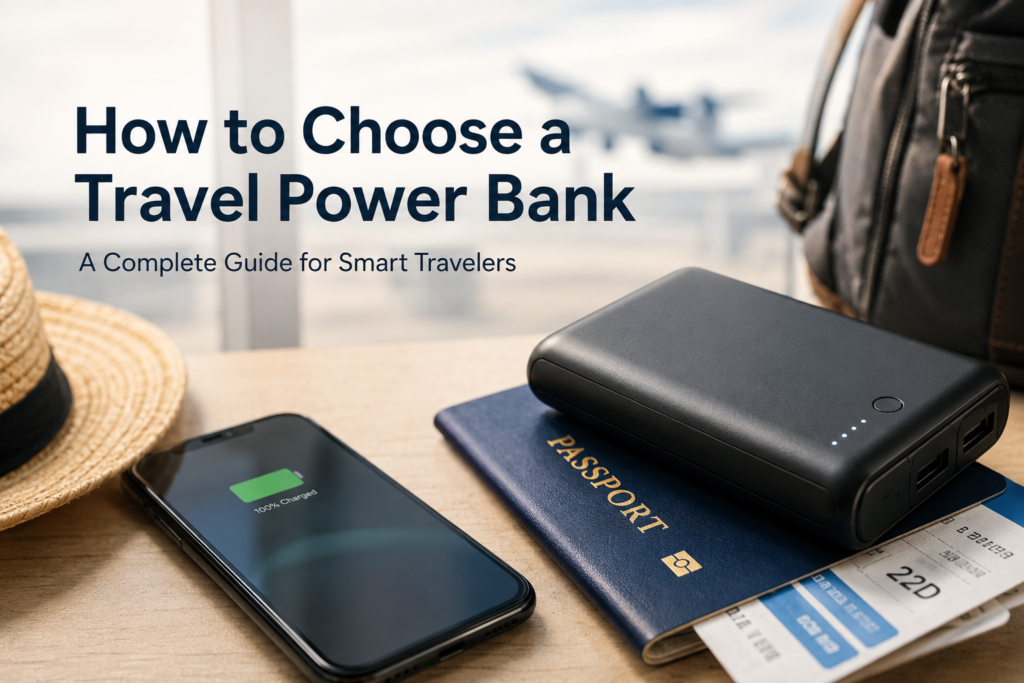
Choosing a travel power bank does not have to be complicated. In my opinion, the best approach is to start with your own travel habits instead of simply looking for the biggest battery or the cheapest price.
Think about how many devices you carry, how long you normally stay away from an outlet, how much weight you are comfortable carrying, and how quickly you need your devices to charge.
For most travelers, a reliable 10,000 mAh or 20,000 mAh power bank with fast USB C charging, good safety features, and a practical design can be an excellent travel companion.
A good travel power bank may seem like a small accessory, but when your phone is almost dead while you are trying to find your hotel, access a boarding pass, or contact someone, it can become one of the most valuable things in your bag.
That is why I believe choosing the right travel power bank is less about buying the most powerful option and more about finding the right balance between capacity, charging speed, portability, safety, and compatibility. Once you understand these factors, it becomes much easier to choose a power bank that fits your travel lifestyle and gives you peace of mind wherever your journey takes you.