 travelandlearns
Related Articles


Traveling by air for the first time can feel confusing, especially when it comes to carry on baggage. Many beginners are unsure about what they can take inside the cabin, how much their carry on bag should weigh, and which items should stay in checked luggage. I believe that understanding carry on baggage rules before reaching the airport can make the entire travel experience much easier.
In this carry on baggage guide for beginners, I will explain the basic rules, useful packing tips, common mistakes, and important items that are usually better to keep in your cabin bag. Airline baggage policies can differ, so I always recommend checking the latest rules of your airline before your journey.
What Is Carry On Baggage?
Carry on baggage is the luggage you take with you into the airplane cabin instead of checking it at the airport counter. Depending on the airline, it may also be called cabin baggage or hand baggage.
A typical carry on bag can be a small suitcase, backpack, travel bag, or another approved piece of luggage. Some airlines also allow passengers to bring a smaller personal item such as a handbag, laptop bag, or small backpack.
The most important thing to understand is that carry on baggage has size and weight limits. These limits are not the same for every airline. Some airlines are generous with cabin baggage, while others have strict restrictions, especially on budget fares.
Why Carry On Baggage Is Important
I personally think carry on baggage is one of the most useful parts of air travel because it allows you to keep important belongings close to you.
Your checked luggage may be separated from you during the journey, but your carry on bag stays with you in the cabin. This makes it ideal for important documents, electronics, medication, valuables, and essential travel items.
A well packed carry on bag can also help if your checked luggage is delayed. You can still have basic clothing, toiletries, chargers, and other necessities until your checked bag arrives.
Check Your Airline Carry On Baggage Rules
One of the biggest mistakes beginners make is assuming that every airline follows the same carry on baggage rules. This is not true.
Before packing, I recommend visiting your airline’s official website and checking the baggage allowance for your exact ticket. Look for information about cabin baggage dimensions, weight restrictions, personal items, and prohibited articles.
Your ticket type can also affect your allowance. Economy, premium economy, business, and first class passengers may have different baggage privileges.
If you have connecting flights with different airlines, check the baggage rules for each airline. The most restrictive allowance may apply to part of your journey.
Carry On Baggage Size and Weight
Carry on baggage size is usually measured by the total height, width, and depth of the bag. Airlines may also include wheels and handles when measuring the dimensions.
Weight limits vary significantly. Some airlines allow relatively heavy cabin bags, while others may impose a lower weight limit. Some carriers focus more on dimensions than weight, but you should never assume this without checking.
I suggest measuring your suitcase at home before traveling. If possible, use a luggage scale to check the weight. It is much easier to remove something from your bag at home than to reorganize everything at the airport.
A bag that looks small enough may still be overweight, so both size and weight matter.
What Should You Pack in Your Carry On?
The best carry on baggage is not necessarily the one filled with the most things. In my opinion, it should contain the items you genuinely need during the journey.
Your passport, visa documents, boarding pass, wallet, phone, and other important travel documents should be easy to access.
Electronics such as a laptop, tablet, camera, headphones, and phone charger are also commonly carried in cabin baggage. Keeping these items with you can provide better security and convenience.
I also recommend carrying basic personal essentials. Depending on the length of your trip, this might include a small amount of clothing, toiletries, tissues, a reusable empty water bottle, and necessary medication.
If you are traveling internationally, keep your travel documents together in one easily accessible section. Searching through a packed suitcase at immigration or security can be frustrating.
Liquids in Carry On Baggage
Liquids are one of the areas that confuse first time travelers.
Airport security rules often place restrictions on liquids, gels, creams, and similar products in cabin baggage. The exact requirements can vary by airport and country, so you should check the airport security guidance for your journey.
Common examples include shampoo, toothpaste, perfume, lotion, liquid makeup, and drinks.
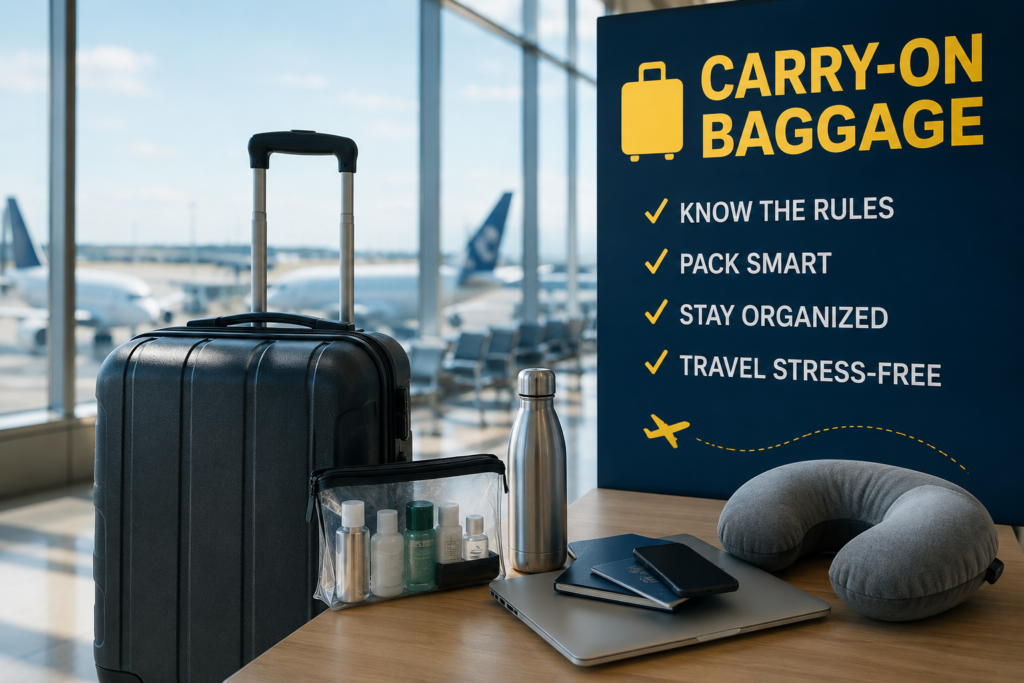
Instead of carrying large bottles, I prefer using small travel sized containers where permitted. Keeping liquid items together in a transparent toiletry bag can also make security screening easier.
Remember that a bottle that is partly empty can still be considered a liquid container based on its capacity. This is why checking the applicable security rules before leaving home is important.
Electronics in Your Carry On
Electronics are generally better kept in your carry on baggage rather than checked luggage.
A laptop, smartphone, camera, tablet, and other valuable electronic devices can be protected more easily when they remain with you. Security officers may also ask you to remove certain electronic devices from your bag during screening.
Keep charging cables organized instead of throwing them randomly into your suitcase. A small cable organizer can save time and prevent cables from becoming tangled.
Power banks and spare lithium batteries also require special attention. Airlines and aviation authorities have specific rules for these items, and they are commonly required to be carried in cabin baggage rather than checked luggage. Always verify the current requirements of your airline before traveling.
Important Documents Should Stay With You
I strongly recommend keeping important documents in your carry on bag.
These may include your passport, visa, travel insurance information, hotel reservation, flight details, identification documents, and other paperwork required for your trip.
Even when many documents are available digitally, I prefer keeping important information accessible offline as well. Your phone battery could run low, or you may not have an internet connection when you need a document.
A simple document folder can keep everything organized.
Items You Should Not Put in Carry On Baggage
Not everything belongs in your cabin bag. Airport security regulations prohibit or restrict certain items because they can create safety risks.
Weapons, sharp objects, dangerous chemicals, explosives, and other restricted articles may not be permitted. Some everyday items can also have specific restrictions depending on their design or purpose.
Do not guess when you are unsure about an item. Check the official airport security or airline guidance before packing it.
The same rule applies to food, medicines, batteries, sports equipment, and unusual travel items. Regulations can vary by destination and airport.
Keep Valuables in Your Carry On
I always recommend keeping valuable and irreplaceable belongings in your carry on baggage whenever permitted.
This can include cash, jewelry, important documents, expensive electronics, and personal items that would be difficult to replace.
You should still avoid carrying unnecessary valuables. The simplest way to travel safely is to bring only what you genuinely need.
Keep your bag closed and within your control whenever possible, particularly in busy airports, security areas, boarding queues, and crowded transportation.
Do Not Overpack Your Carry On
One of the easiest mistakes for beginners is trying to fit too much into a carry on suitcase.
A heavy bag can become uncomfortable when you need to walk through a large airport. It may also exceed your airline’s weight limit.
Instead of packing everything you might possibly need, think about what you will realistically use.
I find it useful to choose versatile clothing that can be worn in different combinations. This reduces unnecessary weight and leaves space for essential items.
Packing cubes can also help organize clothes and make better use of limited space.
Keep Your Carry On Organized
Organization is more important than simply having a large bag.
I recommend placing frequently needed items near the top. Your passport, phone charger, headphones, documents, and other items you may need during the flight should not be buried underneath clothing.
Use separate compartments for electronics, toiletries, documents, and personal items.
Before leaving home, take a few minutes to check the contents of your bag. This small step can help you discover forgotten liquids, prohibited objects, or unnecessary items before reaching airport security.
Carry On Baggage for Connecting Flights
Carry on baggage becomes even more important when you have connecting flights.
During a connection, you may need to move quickly between terminals or go through additional security screening. Keeping essential items in an organized cabin bag makes the process easier.
If your checked baggage is transferred automatically, your carry on bag should still contain everything you need during the connection.
For longer connections, I recommend carrying basic personal items such as a charger, headphones, medication, a light layer of clothing, and essential travel documents.
Common Carry On Baggage Mistakes
There are several mistakes I see beginners making repeatedly.
The first is not checking the airline’s baggage allowance. The second is ignoring the weight limit. Another common mistake is packing restricted items without checking security rules.
Some travelers also put their passport or boarding information at the bottom of the bag. This makes airport procedures unnecessarily stressful.
Overpacking is another problem. A carry on bag should make your journey easier, not become something you struggle to carry.
Finally, never assume that a bag is acceptable simply because you used it on another airline. Different airlines can have different baggage policies.
Final Thoughts on Carry On Baggage
Learning how to pack carry on baggage does not have to be difficult. Once you understand the basic rules, the process becomes much more straightforward.
For me, the best approach is to check the airline requirements first, pack only what I need, keep important documents accessible, protect valuable belongings, and organize everything before reaching the airport.
Remember that carry on baggage rules can change and may vary between airlines, airports, and countries. Always verify the latest requirements before your flight.
With a little preparation, your carry on bag can become one of the most useful parts of your travel setup. Instead of worrying about what you are allowed to bring, you can arrive at the airport feeling prepared and confident.
The main goal of smart carry on packing is simple: take the essentials, follow the rules, stay organized, and keep the journey comfortable.