 travelandlearns
Related Articles


Traveling abroad is exciting, but staying connected can sometimes be challenging. When you are in another country, your regular mobile plan may not work the same way, internet access may be limited, and even simple communication can become difficult if you are not prepared.
In my opinion, staying connected while traveling abroad is not only about using social media or checking messages. A reliable connection can help you find directions, contact your hotel, communicate with family, check travel information, and deal with unexpected situations. With a little preparation before leaving home, you can avoid many common connectivity problems.
In this guide, I will share some practical ways to stay connected while traveling abroad without making the process complicated or unnecessarily expensive.
Check Your Mobile Plan Before Traveling
The first thing I recommend doing is checking your existing mobile plan. Many travelers assume that their phone will automatically work overseas, only to discover expensive roaming charges after arriving at their destination.
Contact your mobile provider or check your account to find out whether international roaming is included. Some plans offer international data, calls, or messages, while others charge separately for each service.
Understanding your plan before leaving home can help you make a better decision. If international roaming is affordable for your destination, it may be the simplest option. If it is expensive, you can consider other ways to get mobile internet.
I always think it is better to know the costs in advance than to receive an unpleasant bill after returning home.
Consider a Local SIM Card
A local SIM card can be a practical option for travelers who need regular internet access. Many countries offer prepaid SIM cards with different amounts of data, calls, and messages.
You can often purchase a local SIM card at an airport, mobile shop, or other authorized retailer. Prices and availability vary depending on the country.
Before purchasing one, make sure your phone is unlocked and compatible with the local network. It is also important to keep your original SIM card somewhere safe if you remove it from your phone.
A local SIM can be particularly useful if you are staying for several weeks or need a large amount of mobile data.
Look Into an eSIM
An eSIM can make international travel even easier if your phone supports it. Instead of physically replacing your SIM card, you can activate a compatible digital mobile plan.
One advantage of an eSIM is that you can often arrange it before your trip. This means you may have mobile data available soon after landing instead of searching for a mobile shop at the airport.
I find this option especially convenient for travelers visiting several countries because some plans can cover multiple destinations.
Before buying an eSIM, check whether your phone supports eSIM technology and whether the plan covers the countries you intend to visit.
Use WiFi When It Makes Sense
WiFi can be an easy way to stay connected abroad. Hotels, cafes, airports, restaurants, and other public places may offer WiFi to customers.
Using WiFi can help reduce mobile data usage, especially when you need to download large files, update applications, or make internet calls.
However, I do not recommend relying entirely on public WiFi. You may not always find a reliable connection when you need one.
For this reason, I prefer having some form of mobile data available as a backup. That way, I can still access maps, transportation information, or messages when WiFi is unavailable.
Download Important Information Before Leaving
One of my favorite travel habits is preparing my phone before the journey. You should not assume that you will always have internet access.
Download maps for the areas you plan to visit when the application supports offline use. Save hotel information, booking details, important addresses, travel documents, and emergency contact information on your device.
You can also take screenshots of important reservations and directions.
This preparation can be extremely useful if your connection suddenly disappears. Instead of becoming stressed, you can simply open the information already stored on your phone.
Choose Communication Apps Carefully
Internet based communication apps can make staying in touch much easier. Depending on what is available in your destination, you may be able to use messaging and calling services instead of traditional international calls.
Before traveling, make sure your family and close contacts know which apps you plan to use.
It is also a good idea to test these apps before leaving home. There is nothing more frustrating than discovering that an application does not work as expected when you are already abroad.
Keep your communication simple. You do not need many different applications if the people you need to contact already use the same reliable service.
Protect Your Phone and Accounts
Staying connected also means keeping your phone secure. Your smartphone may contain personal information, travel documents, photographs, banking applications, and private conversations.
Use a strong screen lock and make sure your device software is updated before traveling.
I also recommend enabling available security features such as device tracking and automatic backups. If your phone is lost or stolen, these features can make it easier to protect your information.
Avoid connecting to unfamiliar networks when possible, especially when handling sensitive accounts. For important activities, use a trusted connection whenever you can.
Carry a Portable Charger
A phone is not very useful if its battery is empty. This is why I consider a portable charger one of the most useful travel accessories.
Navigation, photography, mobile internet, translation tools, and communication can use a lot of battery during a busy travel day.
Carry a suitable portable charger and make sure it is charged before leaving your accommodation.
It is also helpful to charge your phone whenever you have a convenient opportunity. You do not need to wait until the battery is almost empty.
Learn How Your Phone Uses Data
Some applications can use mobile data in the background without you realizing it. Automatic updates, photo backups, video applications, and social media can quickly consume your data allowance.
Before traveling abroad, review your phone settings and restrict unnecessary background data usage.
You can also turn off automatic downloads and updates while using mobile data.
This simple step can help your international data last longer and reduce the chance of unexpected charges.
Keep Important Numbers Available
Even if you plan to communicate mainly through internet applications, keep important telephone numbers available.
Save your hotel, airline, travel provider, family members, and other important contacts before leaving.
You should also know how to contact local emergency services in the country you are visiting.
Do not depend entirely on your contact list being available online. Save important information directly on your phone so that you can access it without an internet connection.
For additional security, you can keep a small written record of the most important numbers in your travel documents.
Use Translation Tools
Language differences can make international travel difficult, especially when you visit a place where you do not speak the local language.
Translation applications can help you communicate with hotel staff, restaurant workers, transportation providers, and local residents.
Some translation tools offer offline features, which can be extremely useful when you do not have internet access.
Before your trip, download the language information you may need and test the application. Learning a few simple local phrases is also worthwhile because it can make everyday communication more comfortable and respectful.
Stay Connected With Family
When traveling abroad, staying in contact with family and friends can provide peace of mind.
You do not have to communicate constantly. A simple message telling someone that you have arrived safely or reached your hotel can be enough.
I prefer setting a simple communication routine when traveling. For example, you might send a message at the end of the day or make a short call when you have reliable internet.
This is especially helpful when traveling alone because someone at home knows where you are and that everything is going well.
Be Careful With Public WiFi
Free WiFi can be convenient, but convenience should not come at the expense of security.
Avoid entering sensitive financial information through unfamiliar public networks whenever possible. If you need to access an important account, consider using your own mobile data or another trusted connection.
Always confirm that you are connecting to the correct network, especially in airports, hotels, and busy public areas.
A little caution can help protect your personal information while traveling.
Have a Backup Connection
Technology can fail, so having a backup plan is always useful.
If your main connection is a local SIM, you might keep WiFi as another option. If you rely on an eSIM, know where you can find public internet if necessary.
You can also download important information for offline use.
The goal is not to carry several expensive connectivity solutions. It is simply to avoid being completely dependent on one method.
Final Thoughts
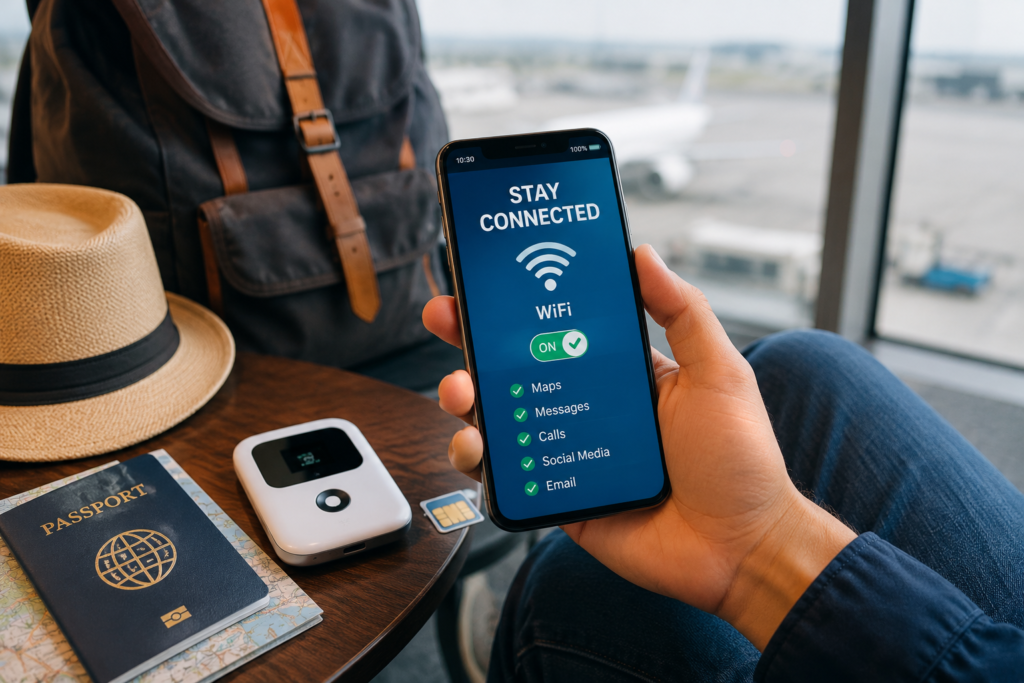
Knowing how to stay connected while traveling abroad can make your journey much easier. A reliable connection helps with communication, navigation, travel planning, translation, reservations, and unexpected situations.
Before leaving home, check your mobile plan and decide whether international roaming, a local SIM, or an eSIM makes the most sense for your trip. Download important information, prepare offline maps, protect your phone, and carry a portable charger.
I believe the best approach is to prepare before you travel rather than trying to solve connectivity problems after you arrive. A few minutes of planning can save you from unnecessary stress later.
At the same time, remember that traveling is also an opportunity to disconnect from your normal routine. Staying connected is useful, but you do not need to spend every moment checking your phone. Use technology when it helps you travel safely and comfortably, then put your phone away and enjoy the destination around you.
With the right preparation, staying connected while traveling abroad can be simple, affordable, and stress free.