 travelandlearns
Related Articles



When I travel, one of the things I always think about before packing is how I am going to keep my devices charged. Our phones, smartwatches, earbuds, cameras, tablets, and other gadgets have become an important part of modern travel. A dead battery can create unnecessary problems, especially when you need your phone for directions, tickets, hotel bookings, communication, or emergency information.
This is why I believe choosing the right travel charger is just as important as choosing the right power bank or travel adapter. However, with so many chargers available, it can be difficult to know which features actually matter.
In my opinion, a good travel charger should be compact, powerful, safe, compatible with your devices, and easy to carry. You do not necessarily need the biggest or most expensive charger. You need one that fits your travel style and charging requirements.
In this guide, I will explain what to look for when choosing travel chargers and which features I think are worth considering.
Choose the Right Charging Power
One of the first things I check when looking at a travel charger is its power output. Charging power is usually measured in watts, and different devices require different amounts of power.
A basic smartphone may not require a very powerful charger, while tablets and laptops can need significantly more power. If you want one charger for multiple devices, choosing a model with a higher power output can give you more flexibility.
For me, the important thing is not simply choosing the charger with the highest wattage. It is about choosing enough power for the devices I actually carry.
If you regularly travel with a laptop, tablet, and smartphone, look for a charger that can comfortably support those devices. If you only carry a phone and earbuds, a smaller charger may be more practical.
Look for Multiple USB Ports
Multiple USB ports are one of the most useful features in a travel charger. Instead of carrying separate chargers for every device, one multi port charger can handle several devices.
I personally prefer having at least two charging ports when traveling because it gives me more flexibility. For example, I can charge my phone while charging my earbuds or smartwatch at the same time.
Some modern chargers include both USB A and USB C ports. This can be useful because many travelers still have older USB accessories while newer devices increasingly use USB C.
Before buying a charger, I recommend checking the ports on the devices you normally carry. There is little benefit in buying a charger with several ports if they are not compatible with your cables.
USB C Support Is Important
USB C has become an important charging standard, so I would strongly recommend considering USB C support when choosing travel chargers.
USB C chargers can support fast charging for many modern smartphones, tablets, laptops, and other devices. They can also reduce the number of different charging accessories you need to carry.
If you are buying a new travel charger today, I think having at least one USB C port is a sensible choice. A charger with multiple USB C ports can be even more useful if most of your devices already use USB C cables.
Check Fast Charging Support
Fast charging can make a big difference during travel. Sometimes you may have only a short amount of time at an airport, hotel, restaurant, or transportation station.
A fast charger can give your device more battery power in less time compared with a basic charger. However, fast charging depends on both the charger and the device.
This is something I think many people overlook. Buying a powerful charger does not automatically mean every device will charge at maximum speed. The charger, cable, and device all need to support the required charging technology.
For this reason, I always recommend checking your device specifications before choosing a fast travel charger.
Consider Charger Size and Weight
Travel is all about saving space. Even a powerful charger becomes less attractive if it is large and heavy.
When I pack for a trip, I prefer accessories that take up very little space. A compact travel charger can easily fit inside a small electronics pouch without taking valuable room in my luggage.
Some modern chargers use newer compact charging technology that allows manufacturers to make powerful chargers smaller than older models.
If you travel frequently, I think the size and weight of a charger are almost as important as its charging performance.
Think About International Compatibility
If you travel internationally, you should think about electrical socket compatibility. Different countries can use different plug designs, so a normal charger may not physically fit into a local wall outlet.
A travel charger and a travel adapter are not exactly the same thing. The charger provides power to your devices, while an adapter allows your plug to connect to a different socket design.
Some travel chargers are designed with built in plug systems or are sold as part of travel charging kits. These can be convenient for international travelers because they reduce the number of separate accessories you need to pack.
I always recommend checking the electrical requirements of your destination before traveling internationally.
Safety Features Matter
Safety is something I would never ignore when choosing a charger. A low quality charger may create unnecessary risks, especially when it is used for long periods.
Look for chargers from reputable manufacturers with appropriate safety protections. Features may include protection against overheating, overcurrent, overvoltage, and short circuits.
I believe spending a little more on a reliable charger can be better than choosing the cheapest option available. A travel charger is connected directly to expensive electronics, so quality matters.
Look at Build Quality
A travel charger will probably experience more handling than a charger that stays at home. It may be placed inside a backpack, moved between hotel rooms, and packed and unpacked several times.
Because of this, I prefer a charger with solid construction and a design that feels durable.
The plug should feel secure, the ports should not feel loose, and the cable connection should be reliable. A good build does not necessarily mean the charger needs to be heavy. A well designed compact charger can still be durable.
Consider GaN Chargers
Gallium nitride, commonly known as GaN, is a charging technology that has become popular because it can allow chargers to be smaller while still providing high power.
For travelers, this can be a major advantage. A compact GaN charger can potentially replace several larger charging bricks.
If I were buying a new travel charger today, I would definitely consider a GaN model, especially if I needed to charge multiple devices or a laptop.
However, I would still focus on the actual specifications rather than buying something simply because the word GaN appears on the packaging.
Check Power Distribution
When a charger has multiple ports, it is important to understand how the available power is distributed between them.
For example, a charger may provide high power when only one port is being used but divide the available power when several devices are connected.
This is not necessarily a problem. It simply means you should understand how the charger works before buying it.
If I am traveling with several devices, I prefer a charger that clearly explains its power distribution. Clear specifications make it easier to know what to expect.
Do Not Forget the Charging Cables
A good charger is only part of the charging setup. You also need the right cables.
A charger may support fast charging, but an unsuitable cable can prevent your device from receiving the expected charging speed.
When I pack for a trip, I like to check all my cables before leaving. I also prefer carrying cables that can work with multiple devices where possible.
It can be useful to keep charging cables in a small organizer so they do not become tangled with other items in your luggage.
Travel Charger or Power Bank?
A travel charger and a power bank serve different purposes. A travel charger needs access to a wall outlet, while a power bank stores energy that you can use when there is no outlet nearby.
For most trips, I think having both can be useful. The charger can handle regular charging in hotels, airports, and other places with electrical outlets, while the power bank can help when you are away from a power source.
If you want to reduce the number of items you carry, you can also consider charging accessories that combine multiple functions. However, I would still choose based on reliability rather than simply trying to reduce the number of gadgets.
Choose Based on Your Devices
There is no single best travel charger for everyone. The right choice depends on what you actually carry.
If you travel with only a smartphone and earbuds, a small dual port charger may be enough. If you carry a laptop, tablet, phone, smartwatch, and other accessories, a higher powered multi port charger makes more sense.
This is why I recommend making a quick list of your devices before buying a charger. Check which charging ports they use and how much power they require.
This simple step can prevent you from buying something that does not meet your needs.
Final Thoughts
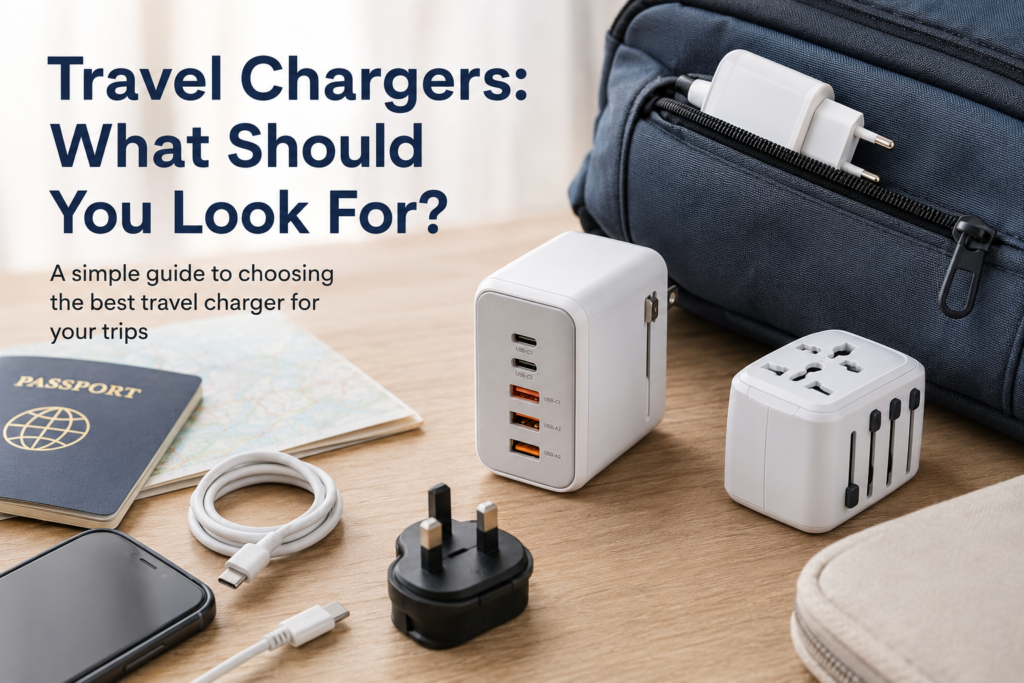
Choosing the right travel charger does not have to be complicated. In my opinion, the most important things to look for are charging power, USB C support, multiple ports, fast charging, compact size, international compatibility, safety features, and good build quality.
I would also pay attention to the charger brand and its specifications instead of choosing only based on price. A reliable travel charger can last through many trips and protect the devices that you depend on while traveling.
For me, the ideal travel charger is one that is small enough to pack easily but powerful enough to handle all my important devices. It should be simple to use, safe, and compatible with the technology I already own.
Before your next trip, take a few minutes to check your devices and charging needs. Once you know exactly what you need, finding the right travel charger becomes much easier. A good charger may be a small part of your luggage, but it can make a surprisingly big difference to the convenience of your entire trip.