 travelandlearns
Related Articles



Connecting flights can look confusing when you are traveling for the first time. You may have questions about changing planes, finding another gate, collecting your luggage, going through security again, or knowing how much time you need between flights. I remember that the idea of changing planes at another airport can feel stressful, especially when you are traveling internationally.
The good news is that connecting flights are usually much easier than they seem. Once you understand how the process works, you can move through the airport with much more confidence. In this guide, I will explain connecting flights for beginners in simple language and share the important things I believe every traveler should know before booking a flight with a connection.
What Is a Connecting Flight?
A connecting flight is a journey that requires you to take more than one airplane to reach your final destination. Instead of flying directly from your departure city to your destination, you stop at another airport and take a second flight.
For example, imagine you are traveling from Lahore to London, but there is no suitable direct flight. Your journey might be Lahore to Dubai and then Dubai to London. Dubai is your connecting airport, while London is your final destination.
The time you spend between the two flights is called a layover. The length of a layover can be short or several hours depending on the flight schedule.
Connecting flights are common because airlines use major airports as hubs where passengers can transfer between different routes.
Why Do Travelers Take Connecting Flights?
In my opinion, the biggest reason people choose connecting flights is price and availability. A direct flight can sometimes be more expensive than a flight with one connection.
Connecting flights can also make destinations accessible when there is no direct route from your city. You may need to change planes because the airline does not operate a direct service to your final destination.
Another advantage is that connecting flights can give you more choices when planning your trip. You may find better departure times, airlines, or ticket prices by accepting a reasonable connection.
However, a cheaper ticket is not always the best choice. You should also consider the length of the layover, airport transfer requirements, baggage arrangements, and the possibility of delays.
What Is a Layover?
A layover is the period between your first flight and your connecting flight.
For example, if your first flight arrives at 2 PM and your next flight leaves at 5 PM, you have a three hour layover.
A longer layover gives you more time to find your gate and handle airport procedures. A very short layover can be stressful because even a small delay on your first flight may affect your second flight.
For beginners, I personally prefer allowing enough time to make the connection comfortably. Saving an hour may not be worth the stress of running through a large airport.
How Much Connection Time Do You Need?
There is no single connection time that works for every airport or journey. The amount of time you need depends on whether you are making a domestic or international connection, whether you need to change terminals, and whether you have to pass through immigration or security.
A connection of several hours can be more comfortable at a large international airport. If your flights are on the same ticket, the airline may provide a connection that meets its minimum connection requirements, but you should still understand what you need to do after landing.
If you are booking separate tickets, you should be much more careful. You may need to collect your baggage, check in again, and go through security. This can require considerably more time.
Same Ticket vs Separate Tickets
This is one of the most important things beginners should understand.
When your entire journey is booked on one ticket or reservation, the airline generally manages the itinerary as one journey. Depending on the airline and route, checked baggage may be transferred to your final destination, and if a disruption causes you to miss the connection, the airline may have responsibilities under its applicable rules and ticket conditions.
Separate tickets are different. If you book one flight from your home city to a connecting airport and another unrelated ticket from that airport to your final destination, you may be responsible for making the connection yourself.
You might need to collect your luggage, check in for the next flight, and pass through security again.
For a first international trip, I would generally avoid very tight connections on separate tickets.
What Happens When You Land?
After your first flight lands, do not simply follow the crowd. Look for airport signs showing connecting flights, transfers, departures, or gates.
Check the airport screens to find your next flight and gate. The gate may be different from the one shown when you first booked your ticket.
If your boarding pass does not show a gate, do not worry. Some airports assign gates later. Continue checking the information screens or the airline app.
If you are unsure, ask airport staff for directions. Asking a simple question is much better than wasting time walking in the wrong direction.
Do You Need to Collect Your Baggage?
Whether you need to collect checked baggage depends on your ticket, airline, airports, and route.
On many connecting itineraries booked together, your checked luggage may be tagged through to your final destination. However, there are situations where you may need to collect and recheck your baggage, especially when crossing borders or when traveling on separate tickets.
Always ask at your first airport where your checked bag is tagged. You can look at the baggage tag or ask the airline employee directly.
Do not assume that your luggage will automatically reach your final destination.
Your carry on bag should contain the things you may need during the connection, such as your passport, travel documents, phone charger, medications, wallet, and other essential items.
Do You Have to Go Through Security Again?
Sometimes you do and sometimes you do not.
Security procedures depend on the airport and your route. You may be able to remain inside the secure transit area, or you may need to pass through security again before reaching your connecting gate.
International connections can also involve immigration or passport control depending on the countries and airports involved.
This is one reason I recommend checking the airport transfer process before traveling. Knowing what to expect can make the connection much less stressful.
What If You Need to Change Terminals?
Large airports can have several terminals, and your connecting flight may depart from another terminal.
Some airports have trains, buses, walkways, or shuttle services connecting terminals. The transfer can take several minutes or considerably longer depending on the airport.
When you land, check the signs for your next terminal. If you are unsure where to go, ask airport staff.
Never assume that two flights at the same airport will use the same terminal.
What Happens If Your First Flight Is Delayed?
Flight delays are one of the biggest concerns when taking connecting flights.
If both flights are part of the same booking and your first flight is delayed enough to cause a missed connection, contact the airline or follow the airline’s instructions. Depending on the circumstances and applicable ticket rules, the airline may rebook you.
If the flights were purchased separately, the situation can be much more complicated. The second airline may consider you a no show if you do not arrive in time.
This is another reason why I recommend avoiding extremely short connections when booking separate tickets.
What Should You Do During a Long Layover?
A long layover does not have to be boring. You can use the time to eat, relax, charge your devices, explore airport shops, or simply rest.
Some airports have lounges where travelers can relax, although access rules and fees vary.
If your layover is extremely long, you may be tempted to leave the airport. Be careful with this decision. You need to know whether you are allowed to enter the country during the layover and whether you have enough time to return, pass through security, and reach your gate.
For beginners, staying inside the airport is often the simpler option when the connection is not long enough for a proper city visit.
Keep Your Important Documents With You
During a connecting flight, keep your important documents somewhere easily accessible.
Your passport, boarding passes, visa documents when applicable, travel insurance information, hotel details, and payment cards should stay in your carry on bag.
Do not place your passport in checked luggage. You may need it during immigration, security, or boarding.
I also recommend keeping digital copies of important documents on your phone or another secure location.
Use Your Layover Wisely
A layover is not only waiting time. It is also an opportunity to prepare for the next part of your journey.
Check your next flight status, confirm the gate, charge your phone, use the restroom, get something to eat, and refill your water bottle where permitted.
If your gate is far away, start walking toward it early. Some airports are surprisingly large, and reaching another terminal or distant gate can take longer than expected.
Do not wait until the final boarding announcement to start looking for your gate.
Common Connecting Flight Mistakes
Beginners often make a few simple mistakes when taking connecting flights.
One common mistake is choosing the shortest possible connection. Another is not checking whether baggage will be transferred. Some travelers also forget to check terminal information or assume the gate shown earlier will remain unchanged.
Another mistake is booking separate tickets without understanding the risks.
I also think it is important not to spend the entire layover sitting somewhere far from your gate. Airports can change gates quickly, so staying aware of your flight information is essential.
Final Thoughts
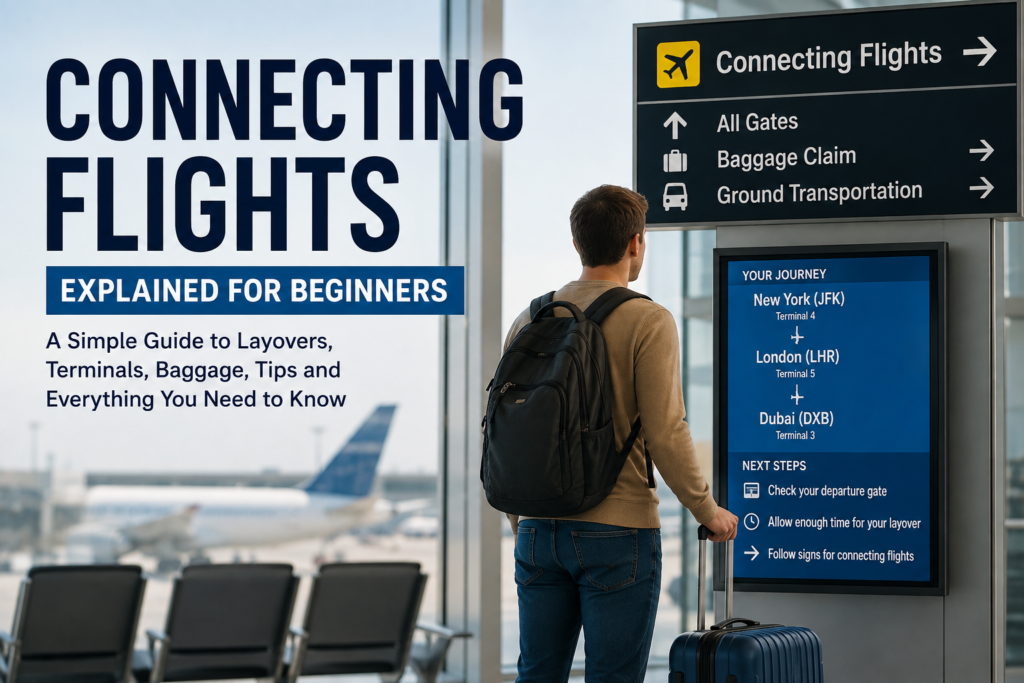
Connecting flights are not something beginners need to fear. They are simply a normal part of international travel, and once you understand the process, they become much easier.
The most important things to remember are your connection time, baggage arrangements, terminal information, security requirements, and whether your flights are booked together or separately.
For your first trip, give yourself enough time to make the connection without rushing. Keep your passport and important documents accessible, follow airport signs, monitor your flight information, and ask airport staff whenever you are unsure.
In my experience, good preparation is the best way to reduce travel stress. Your first connecting flight may feel unfamiliar, but after completing it once, you will probably realize that the process is much simpler than you imagined.
A little planning before departure can turn a confusing airport connection into a smooth and comfortable part of your journey.