 travelandlearns
Related Articles



Planning a multi city trip can be one of the most exciting ways to travel. Instead of staying in one destination for your entire vacation, you can visit several cities and experience different cultures, foods, attractions, and lifestyles during the same journey.
At the same time, a multi city trip requires more planning than a regular vacation. You have to think about transportation between cities, different hotels, travel times, daily activities, luggage, and your overall budget. From my point of view, the key is not to plan every minute. It is to create a simple route that gives you enough time to enjoy each destination without constantly feeling rushed.
In this guide, I will explain how to plan a multi city trip step by step so you can organize your journey with more confidence.
Decide How Many Cities to Visit
The first thing I would decide is how many cities I actually want to visit. More cities do not always mean a better trip.
For a one week vacation, visiting two or three cities may be enough. For a two week international trip, you might comfortably visit three or four cities depending on the distances between them.
I recommend considering the travel time between destinations. If you spend several hours traveling every other day, you may have less time to enjoy the places you came to see.
When planning a multi city itinerary, quality is more important than quantity. I would rather spend four enjoyable days in a city than visit it for one night just to say I was there.
Choose Cities That Make Sense Together
After deciding how many cities you want to visit, create a logical route.
Look at a map and identify destinations that are reasonably connected. For example, if you want to visit several European cities, you may find that trains are convenient between some destinations. In other regions, flights may be more practical.
Try to avoid unnecessary backtracking. If you travel from City A to City B, then City C, it may not make sense to return to City A unless there is a specific reason.
A good multi city trip should feel like a natural journey rather than a series of random bookings.
Set Your Travel Budget
Budgeting becomes even more important when visiting multiple cities.
Start by estimating your international flights, transportation between cities, accommodation, food, sightseeing, local transportation, travel insurance, visa expenses, and shopping.
Remember that prices can vary significantly between destinations. One city might have affordable public transportation and hotels while another could be much more expensive.
I also recommend keeping an emergency fund separate from your main travel budget. Unexpected expenses can happen during any trip, and having extra money can make those situations much easier to handle.
Plan Your Travel Dates
Once you know your destinations, decide how much time you want to spend in each city.
I usually recommend giving more time to places that have many attractions and activities. A large city with museums, historical sites, markets, neighborhoods, and day trips may require several days.
Smaller destinations may need less time.
Also consider your arrival and departure times. If you arrive in a city late in the evening, that day may not really count as a full sightseeing day.
When calculating your itinerary, think about actual usable time rather than simply counting calendar dates.
Book Transportation Between Cities
Transportation is one of the most important parts of a multi city trip.
Depending on your route, you may use airplanes, trains, buses, ferries, rental cars, or a combination of several options.
Before booking, compare the total journey time and cost. A short flight may look cheaper, but once you add airport transportation, baggage fees, and waiting time, a train could sometimes be more convenient.
For international travel, also check baggage rules and transfer requirements carefully.
I prefer to book important transportation in advance when the schedule is fixed. However, if your itinerary is flexible, leaving some room for changes can also be useful.
Consider an Open Jaw Flight
One useful option for multi city travel is an open jaw flight.
Instead of flying into one city and returning from the same airport, you can sometimes fly into one destination and return home from another.
For example, you might fly into Paris, travel through several cities by train, and fly home from Rome.
This can save you from returning to your starting point simply to catch your return flight.
When comparing flight options, always calculate the complete journey rather than looking only at the cheapest round trip ticket.
Book Accommodation Strategically
Accommodation can become complicated when you are changing cities frequently.
Before making reservations, create a simple table or note showing the city, arrival date, departure date, hotel name, and booking confirmation.
I recommend choosing accommodation based on location rather than price alone. A slightly more expensive hotel near public transportation can save money and time during the trip.
Check recent reviews, cancellation policies, check in times, and luggage storage options before booking.
If you arrive before check in time, knowing whether the hotel can store your luggage can be very helpful.
Create a Realistic Daily Itinerary
Once transportation and accommodation are arranged, plan what you want to do in each city.
I prefer creating a list of priority attractions instead of scheduling every hour.
Start with the places you really want to see. Then add restaurants, shopping areas, parks, museums, and other activities around them.
Try to group attractions that are located near each other. This reduces unnecessary travel and gives you more time to enjoy the destination.
Most importantly, leave free time in your itinerary. You may discover a beautiful neighborhood, local market, restaurant, or viewpoint that was not part of your original plan.
Research Local Transportation
Every city can have a different transportation system.
Before arriving, research whether the destination has trains, buses, metro services, taxis, ride sharing services, or rental cars.
Find out how to travel from the airport or train station to your accommodation.
I also recommend downloading useful transportation apps and offline maps before your trip. Having this information available can be extremely helpful if your mobile internet does not work immediately after arrival.
Keep Your Documents Organized
A multi city trip usually involves more reservations and documents than a single destination vacation.
Keep your passport, visas, flight confirmations, hotel reservations, transportation tickets, travel insurance details, and other important documents organized.
I like to keep digital copies of important documents on my phone and another secure location.
Make sure your passport meets the entry requirements for every country you plan to visit. If your trip includes multiple countries, check the visa and transit requirements for each one.
Never assume that entering one country automatically gives you permission to enter another.
Plan Your Luggage Carefully
Changing cities means you will probably handle your luggage more often.
For this reason, I recommend traveling as light as practical.
Pack clothing that can be combined in different ways and choose comfortable shoes. Avoid taking items that you probably will not use.
Before booking transportation, check baggage allowances. Airlines can have different rules, especially when your trip includes several carriers.
A lighter suitcase makes train stations, airports, hotels, and city streets much easier to manage.
Allow Extra Time for Travel Days
One of my biggest recommendations for a multi city trip is to avoid making travel days too complicated.
If you have a train or flight at noon, do not plan an important activity across the city just before departure.
Travel days can involve packing, checking out, reaching the station or airport, waiting, transportation, checking in, and unpacking again.
Give yourself enough time to handle these steps comfortably.
A little extra time can make a major difference when traveling between several destinations.
Research Entry Requirements
If your multi city trip crosses international borders, research entry requirements before departure.
Some countries may require visas, electronic travel authorizations, proof of onward travel, accommodation information, or other documents depending on your nationality.
Requirements can change, so check official government or embassy sources before traveling.
Also research customs rules and any restrictions on items you plan to carry.
Being prepared before leaving home is much easier than trying to solve a documentation problem at an airport.
Keep Your Schedule Flexible
A perfect itinerary does not guarantee a perfect journey.
Flights can be delayed. Trains can be canceled. Weather can change. You may also discover that you enjoy one city much more than expected.
That is why I believe flexibility is essential when planning a multi city trip.
If possible, avoid booking every activity in advance. Reserve the things that require fixed times and keep other activities flexible.
This approach gives you structure without making the trip feel like a strict schedule.
Prepare for Different Cultures
Visiting multiple cities may also mean experiencing different cultures and customs.
Before traveling, learn basic information about local etiquette, food customs, tipping practices, public behavior, and appropriate clothing.
Even learning a few basic local words can make everyday interactions more pleasant.
I also recommend being respectful when visiting religious sites, traditional neighborhoods, and cultural attractions.
Travel becomes more meaningful when you take time to understand the places you visit rather than simply moving from one attraction to another.
Keep a Backup Plan
A backup plan can save you from unnecessary stress.
Write down alternative transportation options, nearby hotels, emergency contact information, and important booking details.
Keep some extra money available and have more than one payment method.
If your phone stops working, you should still have access to essential information such as your accommodation address and transportation details.
You do not need to expect problems. You simply want to be prepared if something does not go according to plan.
Final Thoughts
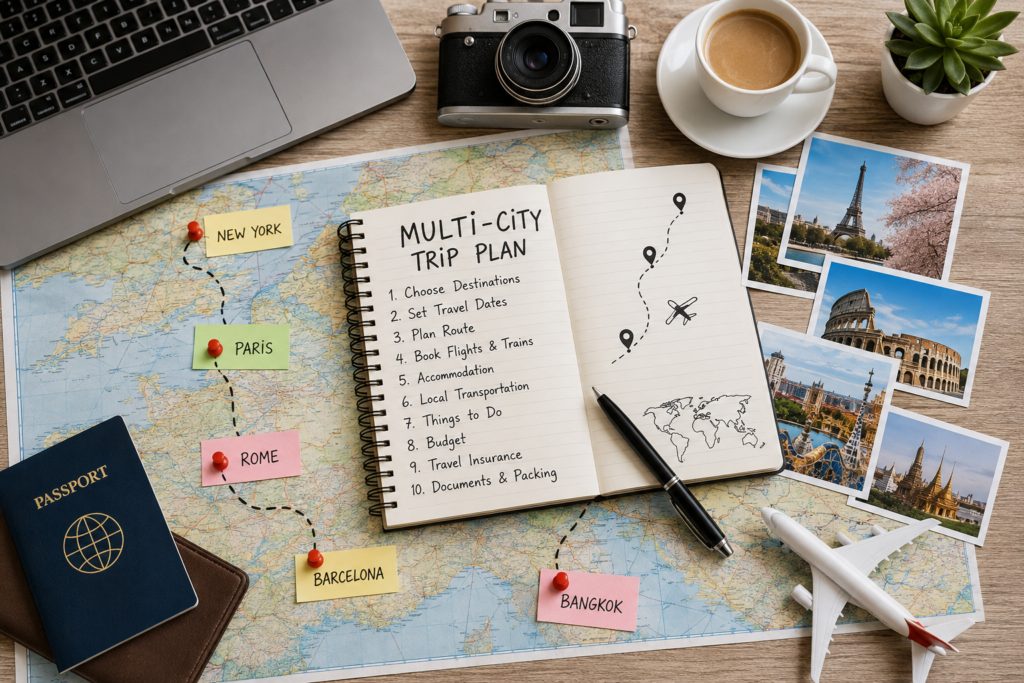
Learning how to plan a multi city trip is mainly about creating a route that works with your time, budget, and travel style.
Start by choosing a reasonable number of destinations. Build a logical route, set a realistic budget, arrange transportation, book well located accommodation, and create a flexible itinerary.
Do not try to see everything. Give yourself enough time to experience each city properly.
From my point of view, the best multi city trips are not the ones with the longest list of destinations. They are the trips where transportation is manageable, the itinerary has breathing room, and you can actually enjoy where you are.
With careful preparation and a little flexibility, a multi city trip can give you an incredible opportunity to explore several destinations while creating memories that last long after you return home.